Language models repeatedly read memory as they generate text, and these reads can limit their speed. We develop probabilistic algorithms and systems for AI inference, optimization, and quantum simulation.
AI, memory, and data movement
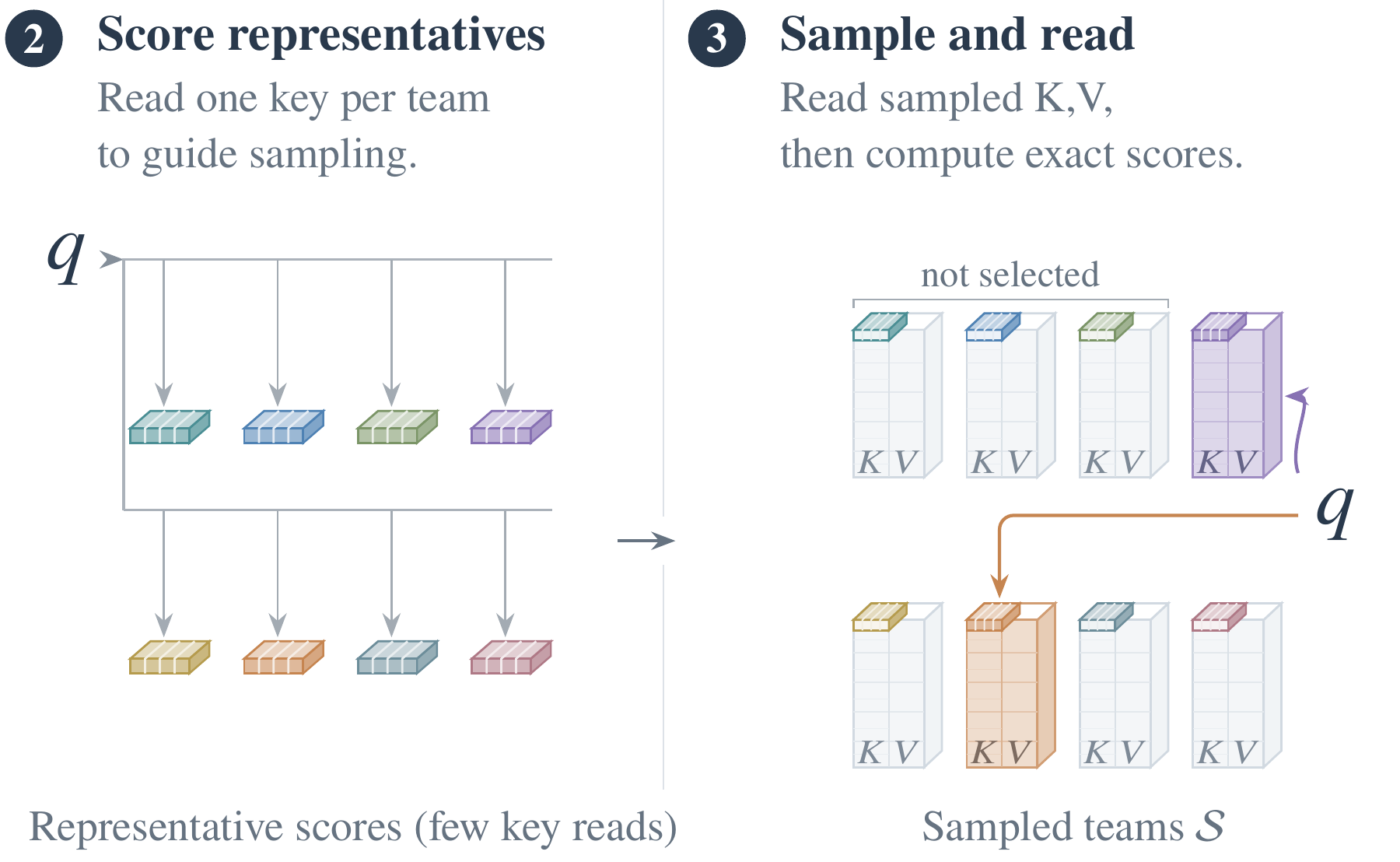
SANTA samples attention probabilities and reads only the selected value vectors. SANTA++ uses representative keys to select groups of cached tokens before reading their members. We implement these methods on GPUs and measure how the sampling budget affects accuracy, memory access, and inference speed. The results also guide hardware for sparse, additive computation.

Representative keys guide which cached keys and values SANTA++ reads. Selection steps, cropped from Lee et al., Figure 1. Full-resolution figure.
We also investigate how physical interactions can guide generative sampling. Our correlated-diffusion work combines a neural network with structured stochastic dynamics, with initial demonstrations on Ising models and spin glasses.
Learning how to search
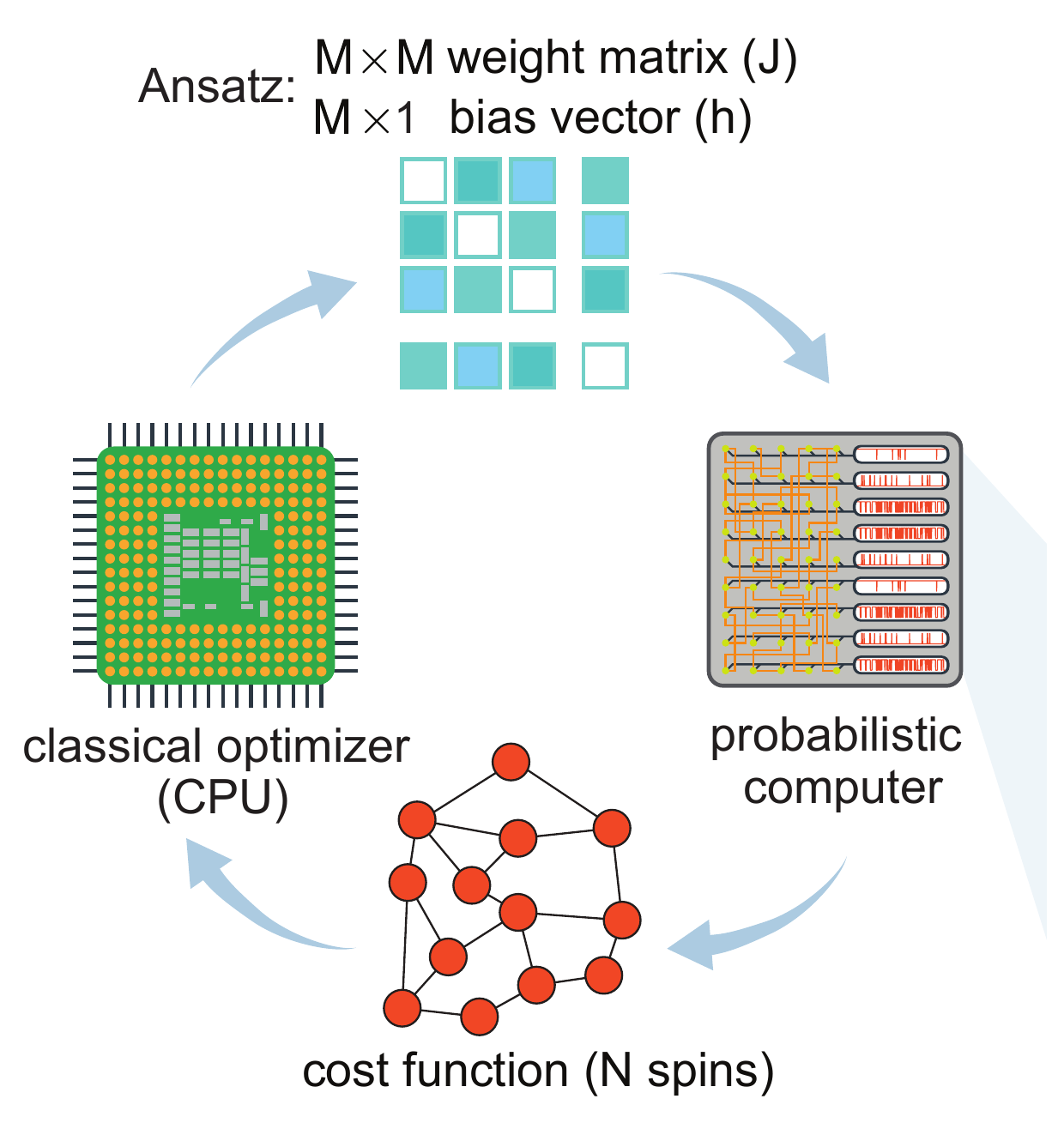
Our generalized Probabilistic Approximate Optimization Algorithm (PAOA) learns how to control stochastic search. It uses the costs of sampled configurations to adjust parameters such as annealing schedules. We compare these learned probabilistic methods with quantum variational algorithms.

PAOA uses sampled costs to update the probabilistic computer’s parameters. Detail from Abdelrahman et al., Figure 1, CC BY 4.0. Full-resolution figure.
We also use learned proposals in parallel tempering. IsingFormer proposes configurations that can move the search between distant regions of the energy landscape.
Probability and quantum computation
We develop classical probabilistic methods for problems also targeted by quantum computers, and revisit comparisons as algorithms and hardware improve. Our spin-glass work tests stronger classical search methods against quantum annealing.
For quantum many-body physics, p-computers accelerate sampling in neural quantum states. Our hardware demonstrations use models with nonnegative ground-state amplitudes. More general quantum systems can require signed or complex amplitudes, whose cancellations create a sign problem for classical sampling.
Architectures that scale
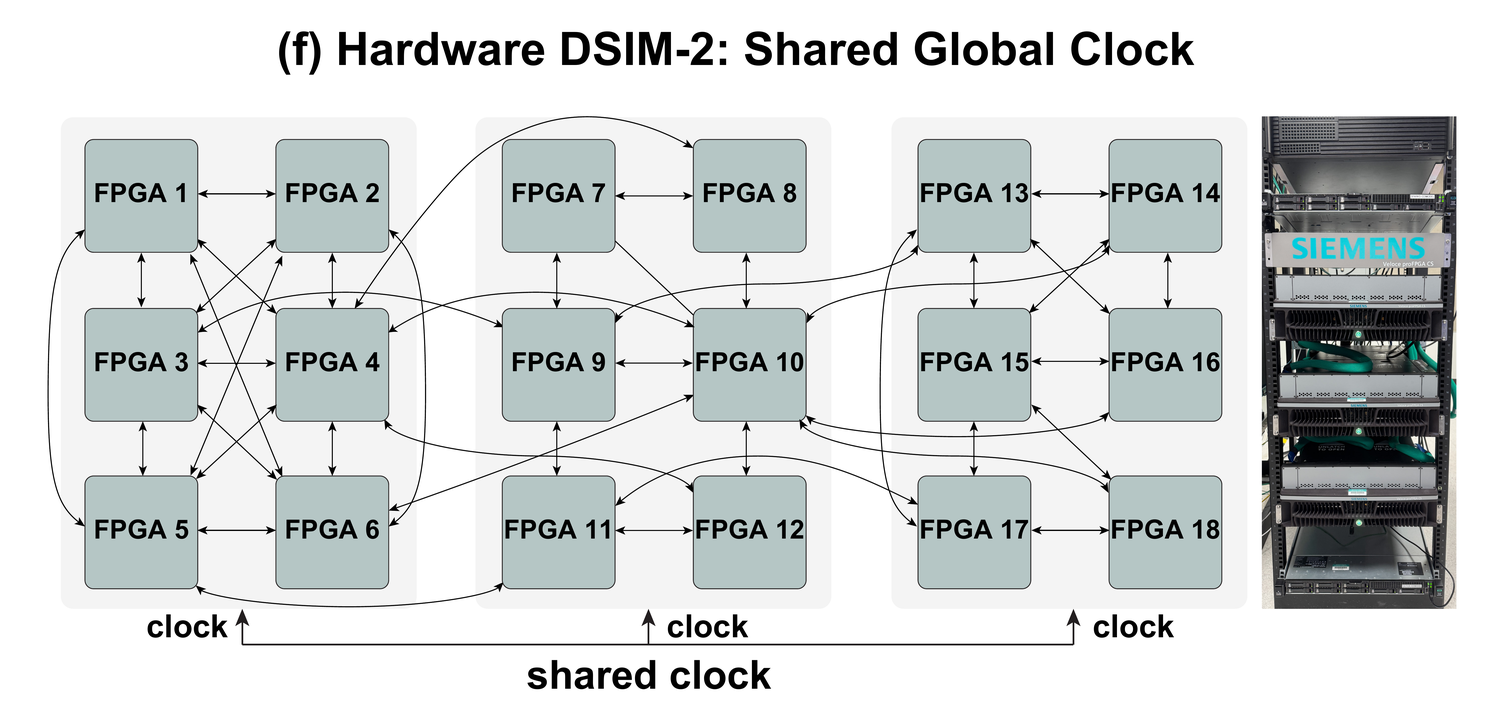
We place interaction weights near the circuits that use them because moving data between devices can be slower than local updates. Our programmable system connects one million p-bits across 18 FPGAs. We study communication delays and methods that divide larger problems into interacting clusters.

The distributed p-computer’s shared-clock architecture and hardware. From Programmable Probabilistic Computer with 1,000,000 p-bits, Figure 1(f). Full-resolution figure.
Selected Recent Papers
-
Probabilistic algorithms for Ising machines from optimization to generative AI. Nature Reviews Electrical Engineering (2026).
-
From Independent to Correlated Diffusion: Generalized Generative Modeling with Probabilistic Computers. Preprint (2026).
-
Stochastic Sparse Attention for Memory-Bound Inference (SANTA). International Conference on Machine Learning (ICML), 2026.
-
SANTA++: Sampling Attention through Representative Keys. Preprint (2026).
-
Programmable Probabilistic Computer with 1,000,000 p-bits. Preprint (2026).
-
IsingFormer: Augmenting Parallel Tempering With Learned Proposals. Preprint (2025).
-
Probabilistic Computers for Neural Quantum States. Preprint (2025).
-
Generalized Probabilistic Approximate Optimization Algorithm. Nature Communications (2026).
-
Pushing the boundary of quantum advantage in hard combinatorial optimization with probabilistic computers. Nature Communications (2025).
Foundational Publications
- N. A. Aadit, A. Grimaldi, M. Carpentieri, L. Theogarajan, J. M. Martinis, G. Finocchio, K. Y. Camsari, Massively parallel probabilistic computing with sparse Ising machines, Nature Electronics, (2022)
-
B. Sutton, R. Faria, L. A. Ghantasala, R. Jaiswal, K. Y. Camsari, S. Datta, Autonomous Probabilistic Coprocessing With Petaflips per Second, IEEE Access, (2020)
-
S. Chowdhury, K. Y. Camsari, S. Datta, Emulating Quantum Circuits With Generalized Ising Machines, IEEE Access 11, 116944-116955 (2023). DOI: 10.1109/ACCESS.2023.3323847.
-
K. Y. Camsari, S. Chowdhury, S. Datta, Scalable Emulation of Sign-Problem-Free Hamiltonians with Room-Temperature p-bits, Physical Review Applied 12, 034061 (2019)
-
K. Y. Camsari, B. M. Sutton, S. Datta, p-bits for probabilistic spin logic, Applied Physics Reviews, 6, 011305 (2019)
-
A. Z. Pervaiz, B. M. Sutton, L. A. Ghantasala, K. Y. Camsari, Weighted p-Bits for FPGA Implementation of Probabilistic Circuits, IEEE Transactions on Neural Networks and Learning Systems, Vol. 30, 6, 1920-1926 (2019)
-
K. Y. Camsari, R. Faria, B. Sutton, S. Datta, Stochastic p-Bits for Invertible Logic, Physical Review X, 7, 031014 (2017)