We develop circuits that generate and control randomness for probabilistic computing. Our building blocks include p-bits, whose binary states fluctuate with electrically controlled probabilities, as well as devices that produce tunable Gaussian random signals. We study how these elements behave when connected into programmable systems.
CMOS+X
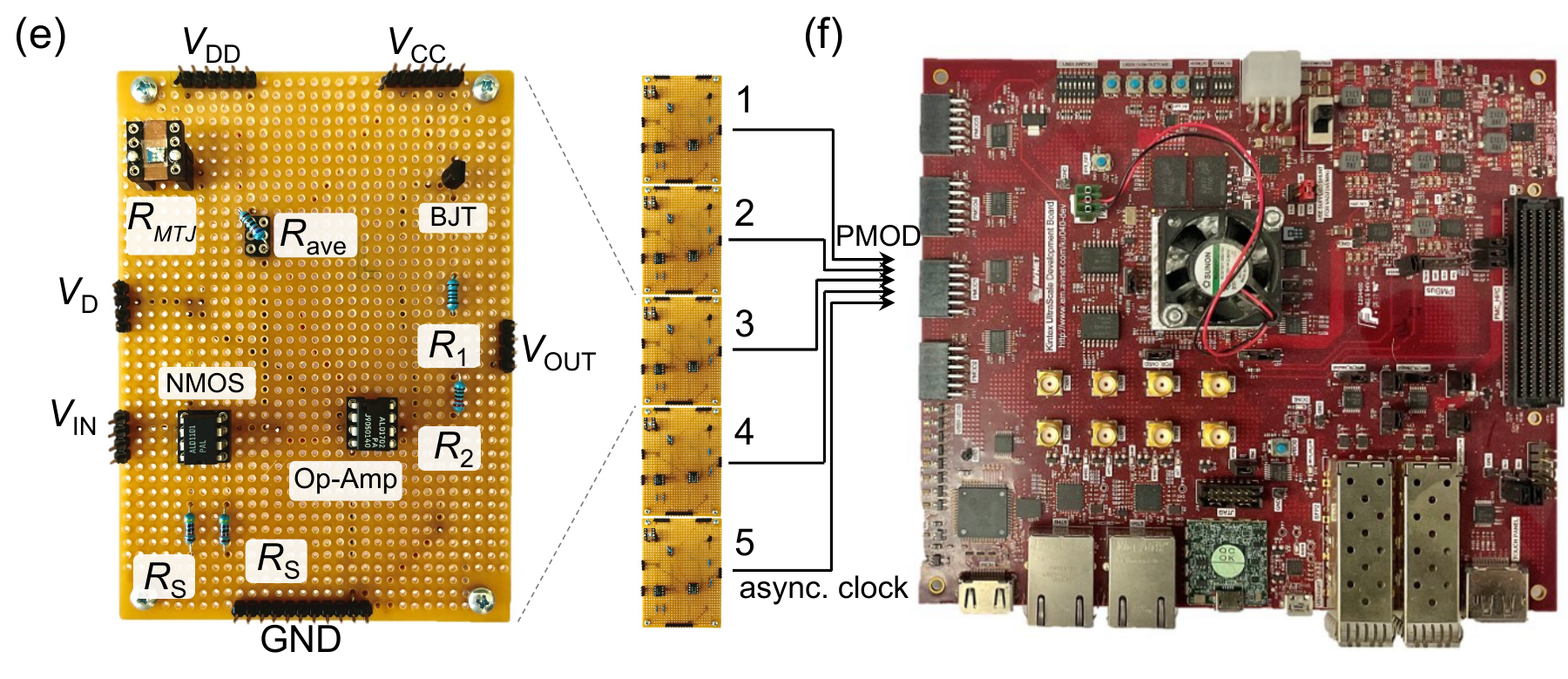
Our CMOS+X approach combines CMOS circuits with stochastic devices, including magnetic tunnel junctions. We also study single-photon avalanche diodes (SPADs) as entropy sources and compare these approaches with fully CMOS implementations. Collaborative work includes a custom CMOS chip supplied by a separate magnetic entropy source.

CMOS+X hardware, cropped from Singh et al., Figure 1(e,f), CC BY 4.0. Full-resolution figure.
Learning with physical circuits
Fabricated circuits differ from their ideal models because their devices and interconnections vary. We develop CMOS probabilistic chips whose measured outputs guide the learning of weights and biases, helping compensate for circuit nonidealities. We also study optimization methods that account for the measured response of SPAD-based p-bits.
Digital probability control
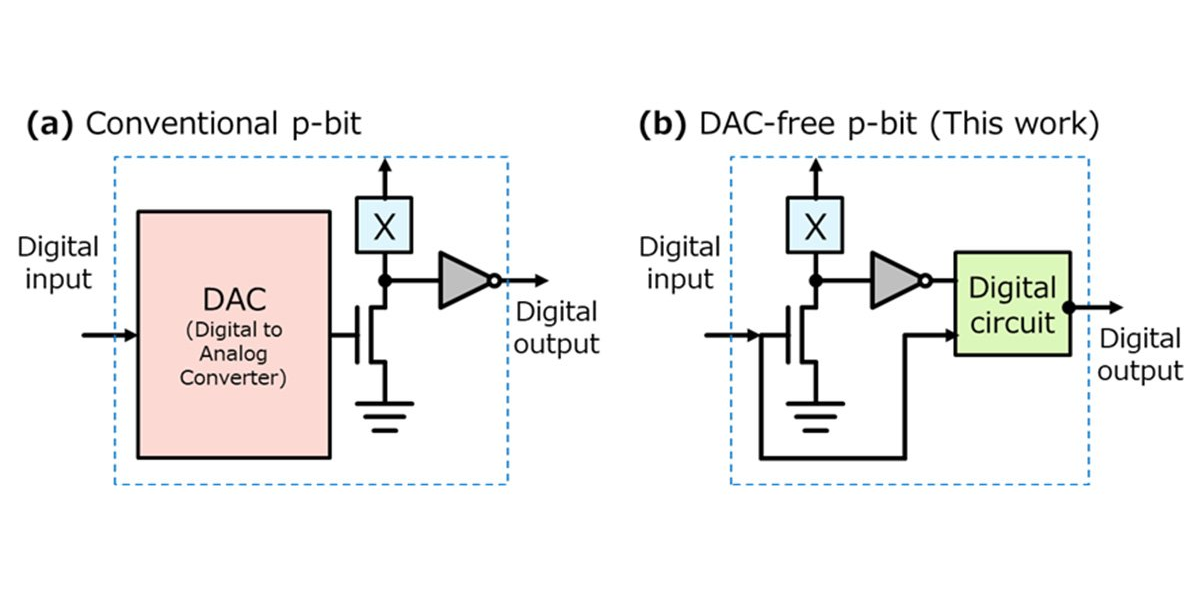
DAC-free p-bits use digital control to tune output probabilities without a digital-to-analog converter at each p-bit.

Digital probability control without a DAC per p-bit. Selcuk et al., DAC-Free p-bits. Image: Shunsuke Fukami, Kerem Camsari et al., via Tohoku University. Full-resolution figure.
Measuring the cost of computation
Coupling stochastic elements, storing weights, and controlling probabilities require circuitry that adds area and consumes energy. We use measured prototypes and circuit models to examine these costs alongside sampling speed and statistical accuracy. These measurements guide integrated designs and identify which device improvements can benefit the complete system.
Recent Publications
- Tunable Gaussian Random Number Generator from a Nanoscopic Domain-Wall-Based Spintronic Device. ACS Nano (2026).
- A CMOS Probabilistic Computing Chip With Hardware-Aware Learning. IEEE Journal on Exploratory Solid-State Computational Devices and Circuits (2026).
- Probabilistic approximate optimization using single-photon avalanche diode arrays. npj Unconventional Computing (in press).
- DAC-Free p-bits: Asynchronous Self-Coloring and On-Chip Annealing. IEDM (2025).
- An integrated-circuit-based probabilistic computer that uses voltage-controlled magnetic tunnel junctions as its entropy source. Nature Electronics (2025).
- CMOS plus stochastic nanomagnets enabling heterogeneous computers for probabilistic inference and learning. Nature Communications (2024).
Foundational Publications
- K. Y. Camsari, M. M. Torunbalci, W. A. Borders, H. Ohno, S. Fukami, Double-Free-Layer Magnetic Tunnel Junctions for Probabilistic Bits, Physical Review Applied 15, 044049 (2021) (Editor's Suggestion) (Physics coverage)
- W. A. Borders, A. Z. Pervaiz, S. Fukami, K. Y. Camsari, H. Ohno, S. Datta, Integer factorization using stochastic magnetic tunnel junctions, Nature, 573, 390-393 (2019)
- A. Z. Pervaiz, S. Datta, K. Y. Camsari, Probabilistic Computing with Binary Stochastic Neurons, 2019 IEEE BiCMOS and Compound semiconductor Integrated Circuits and Technology Symposium (BCICTS), (2019)
- A. Z. Pervaiz, L. A. Ghantasala, K. Y. Camsari, S. Datta, Hardware emulation of stochastic p-bits for invertible logic, Scientific Reports 7, 10994 (2017)
- K. Y. Camsari, S. Salahuddin, S. Datta, Implementing p-bits With Embedded MTJ, IEEE Electron Device Letters, Vol. 38, 12, 1767-1770 (2017)
- B. Sutton, K. Y. Camsari, B. Behin-Aein, S. Datta, Intrinsic optimization using stochastic nanomagnets, Scientific Reports, 7, 44370 (2017)