Home Banner

We study how physics can change what computers can do and what computation costs. We pioneered probabilistic bits, or p-bits, whose states fluctuate with controllable probabilities. By coupling p-bits, we turn physical randomness into a resource for computation.

We use statistical physics to rethink learning and generation in AI, and develop algorithms and hardware to reduce the energy and memory traffic they require. Our work spans algorithms running on today's computers and the design of future probabilistic machines. Building devices and programmable systems lets us test whether computational advantages survive the costs of communication and scaling.

We also investigate the capabilities and limits of probabilistic computers and their relationship with quantum computers. We study how far classical probabilistic methods can go in optimization and quantum simulation, and where quantum interference makes classical sampling difficult. We combine theoretical analysis with hardware and system benchmarks to identify where advantages arise and what resources they require.

 Join OPUS Lab!

We are recruiting!

 Research Areas

We develop probabilistic algorithms and computing systems for AI inference, optimization, and quantum simulation.
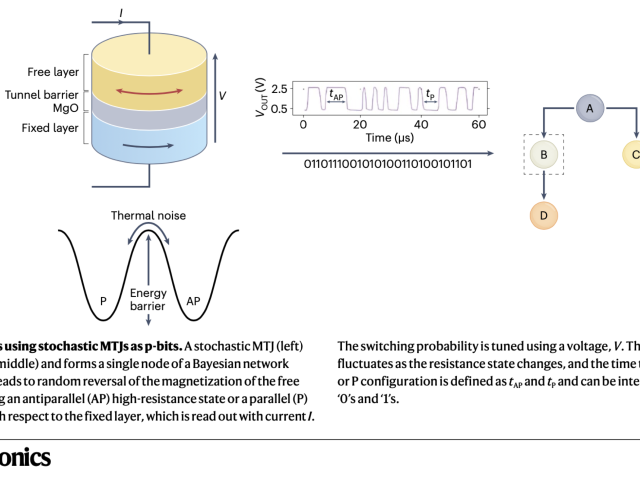
We design and measure stochastic devices and integrated circuits for programmable probabilistic computation.
We study the capabilities and limits of probabilistic computers and their relationship with quantum computers.

 Recent News

April 7, 2024

We are very excited to have Xiuqi Zhang join OPUS Lab as a PhD student for Fall 2024! 


March 27, 2024

Happy to share our work on CMOS + stochastic Magnetic Tunnel Junctions (sMTJ) for probabilistic inference & learning just published in Nature Communications.

March 11, 2024

OPUS Lab welcomes Dr. Corentin Delacour as a postdoctoral scientist!

March 9, 2024

OPUS Lab is part of a MURI on Synchronization in Natural and Engineered Systems! 

January 5, 2024

We are thrilled to have Sajeeb join OPUS Lab in Winter 2024!

December 8, 2023

Jean Anne Incorvia and Sam Liu have put together a thoughtful review of our upcoming IEDM paper. 

November 30, 2023

Kerem Camsari is named IEEE Magnetics Society Distinguished Lecturer for 2024! Kerem is one of the 4 DL's this year who will travel the globe to deliver 20-40 lectures. 

October 5, 2023

Kerem and Navid receive the Bronze Medal (3rd place) in the Bell Labs competition 2023! 

September 27, 2023

We are thrilled to welcome Michael Chen to OPUS Lab! 

September 14, 2023

Nihal Singh's paper is accepted to IEDM 2023.