Home Banner

We study how physics can change what computers can do and what computation costs. We pioneered probabilistic bits, or p-bits, whose states fluctuate with controllable probabilities. By coupling p-bits, we turn physical randomness into a resource for computation.

We use statistical physics to rethink learning and generation in AI, and develop algorithms and hardware to reduce the energy and memory traffic they require. Our work spans algorithms running on today's computers and the design of future probabilistic machines. Building devices and programmable systems lets us test whether computational advantages survive the costs of communication and scaling.

We also investigate the capabilities and limits of probabilistic computers and their relationship with quantum computers. We study how far classical probabilistic methods can go in optimization and quantum simulation, and where quantum interference makes classical sampling difficult. We combine theoretical analysis with hardware and system benchmarks to identify where advantages arise and what resources they require.

 Join OPUS Lab!

We are recruiting!

 Research Areas

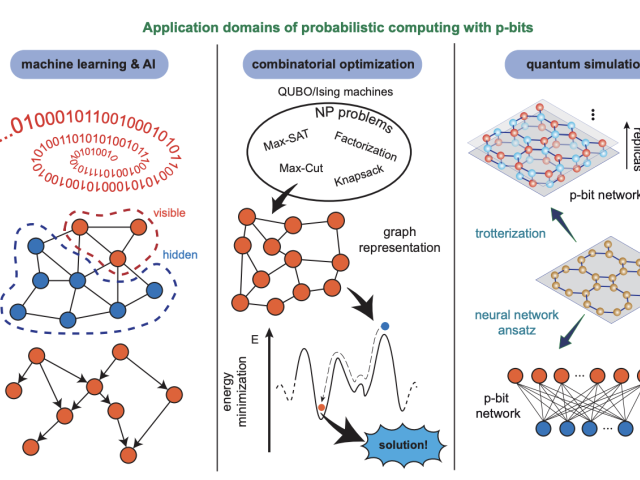
We develop probabilistic algorithms and computing systems for AI inference, optimization, and quantum simulation.
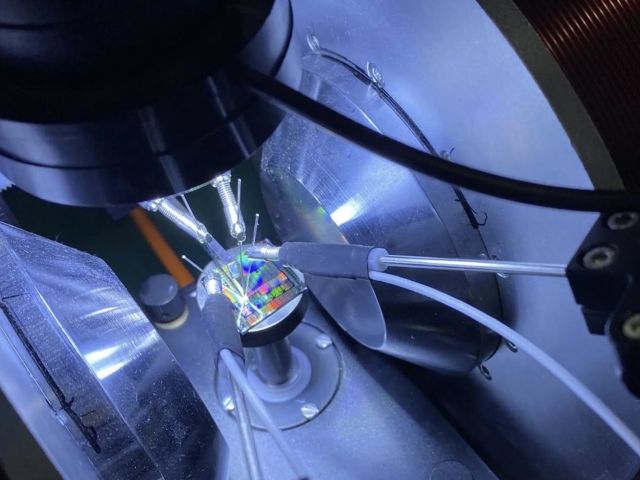
We design and measure stochastic devices and integrated circuits for programmable probabilistic computation.
We study the capabilities and limits of probabilistic computers and their relationship with quantum computers.

 Recent News

April 6, 2023

Navid starts an internship at the Universities Space Research Association. 

March 22, 2023

We are excited to be part of a 5 year $7.5M MURI project on "Supremacy Over Quantum: Efficient Real-World Optimization on Stochastic Binary Networks" including teams from UC Santa Barbara, UC Berkeley,  Cornell & Purdue University!

March 15, 2023

Excited to announce the recent publication of our paper in IEEE JxCDC, titled "A Full-Stack View of Probabilistic Computing with P-bits: Devices, Architectures, and Algorithms." This comprehensive review explores the potential of p-bits as a solution to the growing energy consumption and computational demands of modern AI algorithms.

February 2, 2023

A comprehensive and informative article by James Badham on our lab's recent CAREER award is out. 

January 11, 2023

Our group receives the prestigious NSF CAREER award to build hybrid probabilistic computers! 

January 4, 2023

We are thrilled to have UCSB sophomore Kyle Lee to join OPUS Lab as an undergraduate researcher!

December 9, 2022

IEEE Spectrum covers latest advances in probabilistic computing presented at the IEDM, featuring our paper and a history of p-bits.


October 31, 2022

Our collaborative paper with Shriram Ramanathan's group at Rutgers University is out in Nano Letters.

Congratulations Kemal Selçuk and Navid Anjum Aadit! 

October 17, 2022

OPUS Lab receives SRC support under the Hardware for AI program to develop scaled out probabilistic computing architectures! 

October 8, 2022

We are excited to have Shuvro Chowdhury who joins OPUS Lab as a postdoctoral researcher.