We study how physics can change what computers can do and what computation costs. We pioneered probabilistic bits, or p-bits, whose states fluctuate with controllable probabilities. By coupling p-bits, we turn physical randomness into a resource for computation.
We use statistical physics to rethink learning and generation in AI, and develop algorithms and hardware to reduce the energy and memory traffic they require. Our work spans algorithms running on today's computers and the design of future probabilistic machines. Building devices and programmable systems lets us test whether computational advantages survive the costs of communication and scaling.
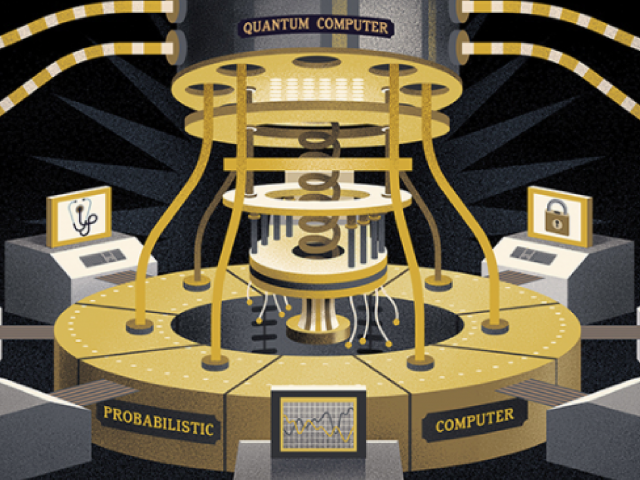
We also investigate the capabilities and limits of probabilistic computers and their relationship with quantum computers. We study how far classical probabilistic methods can go in optimization and quantum simulation, and where quantum interference makes classical sampling difficult. We combine theoretical analysis with hardware and system benchmarks to identify where advantages arise and what resources they require.
Join OPUS Lab!
We are recruiting!