Home Banner

We study how physics can change what computers can do and what computation costs. We pioneered probabilistic bits, or p-bits, whose states fluctuate with controllable probabilities. By coupling p-bits, we turn physical randomness into a resource for computation.

We use statistical physics to rethink learning and generation in AI, and develop algorithms and hardware to reduce the energy and memory traffic they require. Our work spans algorithms running on today's computers and the design of future probabilistic machines. Building devices and programmable systems lets us test whether computational advantages survive the costs of communication and scaling.

We also investigate the capabilities and limits of probabilistic computers and their relationship with quantum computers. We study how far classical probabilistic methods can go in optimization and quantum simulation, and where quantum interference makes classical sampling difficult. We combine theoretical analysis with hardware and system benchmarks to identify where advantages arise and what resources they require.

 Join OPUS Lab!

We are recruiting!

 Research Areas

We develop probabilistic algorithms and computing systems for AI inference, optimization, and quantum simulation.
We design and measure stochastic devices and integrated circuits for programmable probabilistic computation.
We study the capabilities and limits of probabilistic computers and their relationship with quantum computers.

 Recent News

September 15, 2022

Experimental evaluation of simulated quantum annealing with MTJ-augmented p-bits has been accepted to IEDM 2022! Congratulations Andrea, Navid, Kemal, Shawn and Keito. 

August 15, 2022

We are very excited to have Saleh Bunaiyan join OPUS lab!

July 16, 2022

We are thrilled to host Keito Kobayashi from Tohoku University as a visiting graduate student. 

July 5, 2022

We are excited to have Nihal Singh join our team! 

July 1, 2022

Kerem gives an overview of OPUS Lab's latest work on p-bits at UNAM. 

June 2, 2022

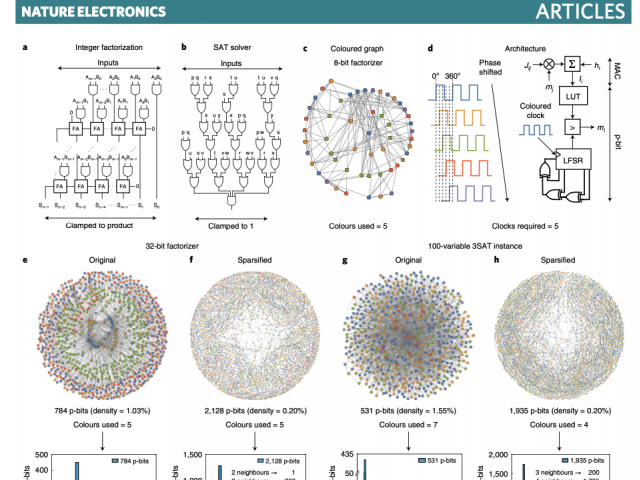
We are excited to share Sparse Ising Machines with p-bits are now out in Nature Electronics. Also check out the coverage by the College of Engineering. 
 

May 13, 2022

OPUS Undergraduate Researcher Andrea Ni has been selected as a Texas Instruments URP Scholar by SRC. Congratulations Andrea!

February 22, 2022

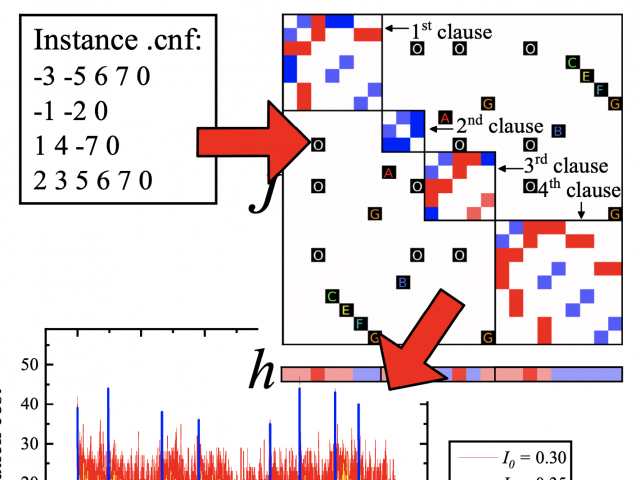
Andrea and Navid's paper shows how invertible logic with p-bits can be useful to solve maximum satisfiability problems using sophisticated optimization algorithms such as parallel tempering. 

January 31, 2022

We are awarded an ONR grant to work on Scalable Probabilistic Computers for Optimization and Quantum Simulation.

January 25, 2022

We are thrilled to welcome Andrea as a visiting PhD student!